Buy qeu.eu ?
We are moving the project
qeu.eu .
Are you interested in purchasing the domain
qeu.eu ?
domain@kv-gmbh.de · 0541-91531010
Buy qeu.eu ?
What is the household optimum in microeconomics?
The household optimum in microeconomics refers to the point at which a household maximizes its utility or satisfaction given its budget constraint. This occurs when the household allocates its limited resources in such a way that the marginal utility per dollar spent is equal across all goods and services. In other words, the household is making the most efficient use of its income to achieve the highest level of satisfaction possible. This concept is a key principle in consumer theory and helps individuals make rational decisions about how to allocate their resources. **
What is the price ratio in microeconomics?
The price ratio in microeconomics refers to the relative prices of two goods or services. It is a comparison of the prices of two items, showing how much of one good or service can be obtained in exchange for another. The price ratio is important in determining consumer preferences and choices, as well as in analyzing the relative value of different goods and services in the market. It is a key concept in understanding consumer behavior and market dynamics in microeconomics. **


Similar search terms for Microeconomics
Top-Angebote
Products related to Microeconomics:
-
Novadiet Prosnova Progress 60 CapsulesNutrition and Supplements Special supplements Novadiet Prosnova Progress 60 Capsules If you're a man over 40, you've likely begun to notice urinary problems. Benign prostatic hyperplasia (BPH) is the most common reason for male urological consultations. It begins to manifest itself after the age of 40, affecting 80% of men by age 70 and 90% of those over 85. It is a benign, age-related enlargement of the prostate, associated with low testosterone levels, a slow-growing condition that causes significant discomfort and significantly impacts quality of life. Prostate growth compresses the urethra as it passes through the gland, causing a series of secondary discomforts: difficulty starting to urinate; a thin, weak, and intermittent urine stream; a feeling of not having emptied the bladder after urinating; having to urinate multiple times during the day (pollakiuria) and at night (nocturia); urinary incontinence, abdominal pain, and discomfort when urinating may also occur. Take one capsule with breakfast and another with dinner, with water. Recommended daily dose: 2 capsules.15,92 £*Shipping: 3,99 £Secure redirect to the provider
-
HARPERCOLLINS Creative Confidence by Tom & David Kelley – Unleashing Your Creative Potential & Innovation MindsetA powerful and inspiring book from the founders of IDEO, the award-winning design firm, on unleashing the creativity that lies within each and every one of us. Too often, companies and individuals assume that creativity and innovation are the domain of the ‘creative types’. But two of the foremost experts in innovation, design and creativity on the planet show us that each and every one of us is creative. In an entertaining and inspiring narrative that draws on countless stories from their work at IDEO, and with many of the world's top companies and design firms, David and Tom Kelley identify the principles and strategies that will allow us to tap into our creative potential in our work lives, and in our personal lives, allow us to think outside the box in terms of how we approach and solve problems. ‘Creative Confidence’ is a book that will help each of us be more productive and successful in our lives and in our careers.4,95 £*Shipping: 1,99 £Secure redirect to the provider
-
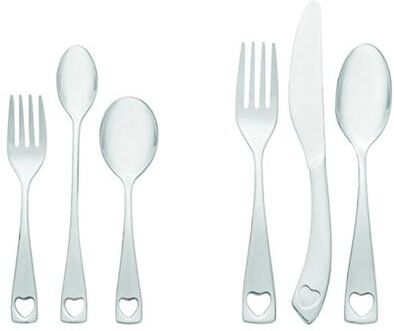
Oneida Little Love 6 Piece Fine Flatware Progress SetNew or experienced, moms need some help. Gift them easier table training with a Little Love for their little ones. Punched heart shapes entertain while including kids with age-appropriate sizes, durable stainless steel, and easy-to-maneuver designs.37,99 $*Shipping: 0,00 $Secure redirect to the provider


-
What is more difficult for you, microeconomics or macroeconomics?
For me, macroeconomics is more difficult than microeconomics. Microeconomics deals with individual economic agents and their decision-making, which I find easier to understand and apply. On the other hand, macroeconomics involves analyzing the economy as a whole, including factors like inflation, unemployment, and economic growth, which I find more complex and challenging to grasp. The interconnectedness of various economic variables in macroeconomics makes it more difficult for me to fully comprehend and analyze. **
-
What are the static and dynamic perspectives of microeconomics using an example from business theory? What is meant by the dynamic perspective in microeconomics?
The static perspective of microeconomics focuses on analyzing the current state of an economy or market, without considering changes over time. For example, in business theory, static analysis might involve examining the current supply and demand for a product to determine the equilibrium price. On the other hand, the dynamic perspective of microeconomics considers how markets and economies change over time. For instance, in business theory, dynamic analysis might involve studying how changes in consumer preferences or technology impact the demand for a product and how firms adjust their production and pricing strategies in response. The dynamic perspective in microeconomics refers to the study of how markets and economies evolve and adapt to changes over time. **
-
Looking for help in microeconomics for calculating the marginal rate of substitution.
To calculate the marginal rate of substitution in microeconomics, you need to find the ratio at which a consumer is willing to trade one good for another while maintaining the same level of utility. This can be calculated by taking the ratio of the marginal utility of the good being given up to the marginal utility of the good being gained. By comparing the additional satisfaction gained from consuming one more unit of a good to the satisfaction lost from consuming one less unit of another good, you can determine the marginal rate of substitution. **
-
I am looking for help in microeconomics to calculate the marginal rate of substitution.
To calculate the marginal rate of substitution (MRS) in microeconomics, you can use the formula MRS = - (MUx / MUy), where MUx is the marginal utility of good X and MUy is the marginal utility of good Y. The MRS represents the rate at which a consumer is willing to trade one good for another while maintaining the same level of utility. It measures the amount of good Y that a consumer is willing to give up in exchange for one more unit of good X. By calculating the MRS, you can understand how a consumer allocates their resources and makes trade-offs between different goods. **


How are microeconomics, Keynes, unemployment, Jean Baptiste, and neoclassical economics related to the state?
Microeconomics is the study of individual economic behavior and decision-making, which can have implications for the overall state of the economy. Keynes was an influential economist who developed theories on how to address unemployment and economic downturns through government intervention. Unemployment is a key economic indicator that reflects the state of the economy and the well-being of its citizens. Jean Baptiste Say was a classical economist who argued that supply creates its own demand, which has implications for government policies and economic management. Neoclassical economics is a school of thought that emphasizes the efficiency of markets and the role of individual decision-making, which can inform government policies and regulations. Overall, these concepts are all related to the state through their influence on economic policies, government intervention, and the overall well-being of the economy and its citizens. **
What is an example of perfect competition, monopoly, and first-degree price discrimination in microeconomics?
An example of perfect competition is the agricultural industry, where there are many small farmers producing identical products such as wheat or corn. In contrast, a monopoly example would be a company like Microsoft, which dominates the market for operating systems. First-degree price discrimination can be seen in the airline industry, where airlines charge different prices for the same seat based on factors like time of booking, demand, and customer willingness to pay. **
Top-Angebote
Products related to Microeconomics:
-
Pan Make Brilliant Work: Lessons on Creativity, Innovation and Success by Rod Judkins - Paperback - Self-Help/Business Creativity Guide, Author ofMake Brilliant Work is an inspiring guide by Rod Judkins, drawing on the real-life stories of visionaries from Frida Kahlo to Steve Jobs. This paperback book reveals the methods and mindsets that turn ordinary effort into extraordinary results. Judkins proves that talent alone never guaranteed success — persistence, risk-taking and original thinking did. A motivating read for anyone wanting to unlock their creative potential at work or in life. The book profiles figures who failed at school, were told they lacked talent, or were fired more than once, yet went on to achieve great things. Written by Rod Judkins, published by Pan Macmillan, this book is a reassuring truth: you don't have to be naturally brilliant to produce brilliant work.2,99 £*Shipping: 2,99 £Secure redirect to the provider
-
Uplift Treasures Adjustable Car Accessibility Safety Handle Adjustable Car Accessibility Safety HandleProduct Description Make getting in and out of your vehicle safer and easier with this adjustable car accessibility safety handle. Designed to provide reliable support without tools, it installs quickly and offers a secure grip for seniors,...39,97 $*Shipping: 0,00 $Secure redirect to the provider
-
Novadiet Prosnova Progress 60 CapsulesNutrition and Supplements Special supplements Novadiet Prosnova Progress 60 Capsules If you're a man over 40, you've likely begun to notice urinary problems. Benign prostatic hyperplasia (BPH) is the most common reason for male urological consultations. It begins to manifest itself after the age of 40, affecting 80% of men by age 70 and 90% of those over 85. It is a benign, age-related enlargement of the prostate, associated with low testosterone levels, a slow-growing condition that causes significant discomfort and significantly impacts quality of life. Prostate growth compresses the urethra as it passes through the gland, causing a series of secondary discomforts: difficulty starting to urinate; a thin, weak, and intermittent urine stream; a feeling of not having emptied the bladder after urinating; having to urinate multiple times during the day (pollakiuria) and at night (nocturia); urinary incontinence, abdominal pain, and discomfort when urinating may also occur. Take one capsule with breakfast and another with dinner, with water. Recommended daily dose: 2 capsules.15,92 £*Shipping: 3,99 £Secure redirect to the provider
-
What is the household optimum in microeconomics?
The household optimum in microeconomics refers to the point at which a household maximizes its utility or satisfaction given its budget constraint. This occurs when the household allocates its limited resources in such a way that the marginal utility per dollar spent is equal across all goods and services. In other words, the household is making the most efficient use of its income to achieve the highest level of satisfaction possible. This concept is a key principle in consumer theory and helps individuals make rational decisions about how to allocate their resources. **
-
What is the price ratio in microeconomics?
The price ratio in microeconomics refers to the relative prices of two goods or services. It is a comparison of the prices of two items, showing how much of one good or service can be obtained in exchange for another. The price ratio is important in determining consumer preferences and choices, as well as in analyzing the relative value of different goods and services in the market. It is a key concept in understanding consumer behavior and market dynamics in microeconomics. **
-
What is more difficult for you, microeconomics or macroeconomics?
For me, macroeconomics is more difficult than microeconomics. Microeconomics deals with individual economic agents and their decision-making, which I find easier to understand and apply. On the other hand, macroeconomics involves analyzing the economy as a whole, including factors like inflation, unemployment, and economic growth, which I find more complex and challenging to grasp. The interconnectedness of various economic variables in macroeconomics makes it more difficult for me to fully comprehend and analyze. **
-
What are the static and dynamic perspectives of microeconomics using an example from business theory? What is meant by the dynamic perspective in microeconomics?
The static perspective of microeconomics focuses on analyzing the current state of an economy or market, without considering changes over time. For example, in business theory, static analysis might involve examining the current supply and demand for a product to determine the equilibrium price. On the other hand, the dynamic perspective of microeconomics considers how markets and economies change over time. For instance, in business theory, dynamic analysis might involve studying how changes in consumer preferences or technology impact the demand for a product and how firms adjust their production and pricing strategies in response. The dynamic perspective in microeconomics refers to the study of how markets and economies evolve and adapt to changes over time. **
Similar search terms for Microeconomics
-
HARPERCOLLINS Creative Confidence by Tom & David Kelley – Unleashing Your Creative Potential & Innovation MindsetA powerful and inspiring book from the founders of IDEO, the award-winning design firm, on unleashing the creativity that lies within each and every one of us. Too often, companies and individuals assume that creativity and innovation are the domain of the ‘creative types’. But two of the foremost experts in innovation, design and creativity on the planet show us that each and every one of us is creative. In an entertaining and inspiring narrative that draws on countless stories from their work at IDEO, and with many of the world's top companies and design firms, David and Tom Kelley identify the principles and strategies that will allow us to tap into our creative potential in our work lives, and in our personal lives, allow us to think outside the box in terms of how we approach and solve problems. ‘Creative Confidence’ is a book that will help each of us be more productive and successful in our lives and in our careers.4,95 £*Shipping: 1,99 £Secure redirect to the provider
-
Oneida Little Love 6 Piece Fine Flatware Progress SetNew or experienced, moms need some help. Gift them easier table training with a Little Love for their little ones. Punched heart shapes entertain while including kids with age-appropriate sizes, durable stainless steel, and easy-to-maneuver designs.37,99 $*Shipping: 0,00 $Secure redirect to the provider
-
Sirius Dice - Progress Pride Dice Set - Rainbow-Coloured - Board GamesAdd colour and meaningful representation to your tabletop games with this Progress Pride dice set from Sirius Dice. Designed for Dungeons & Dragons players, the set features clear dice with rainbow-coloured numbering and an embedded Progress Pride flag detail in every die. The vibrant colour treatment makes the numbers easy to distinguish during play, while the compact set is suitable for adventurers, Dungeon Masters, and collectors alike. It's a distinctive accessory for regular game sessions, character creation, and display.16,77 £*Shipping: 3,95 £Secure redirect to the provider
-
Roommates Minions Science In Progress Grey Peel and Stick WallpaperCelebrate curiosity and creativity with this Minions peel and stick wallpaper inspired by lab sketches and inventive graphics, blending modern design with the Minions' wonderfully unpredictable spirit.59,99 $*Shipping: 0,00 $Secure redirect to the provider
-
Looking for help in microeconomics for calculating the marginal rate of substitution.
To calculate the marginal rate of substitution in microeconomics, you need to find the ratio at which a consumer is willing to trade one good for another while maintaining the same level of utility. This can be calculated by taking the ratio of the marginal utility of the good being given up to the marginal utility of the good being gained. By comparing the additional satisfaction gained from consuming one more unit of a good to the satisfaction lost from consuming one less unit of another good, you can determine the marginal rate of substitution. **
-
I am looking for help in microeconomics to calculate the marginal rate of substitution.
To calculate the marginal rate of substitution (MRS) in microeconomics, you can use the formula MRS = - (MUx / MUy), where MUx is the marginal utility of good X and MUy is the marginal utility of good Y. The MRS represents the rate at which a consumer is willing to trade one good for another while maintaining the same level of utility. It measures the amount of good Y that a consumer is willing to give up in exchange for one more unit of good X. By calculating the MRS, you can understand how a consumer allocates their resources and makes trade-offs between different goods. **
-
How are microeconomics, Keynes, unemployment, Jean Baptiste, and neoclassical economics related to the state?
Microeconomics is the study of individual economic behavior and decision-making, which can have implications for the overall state of the economy. Keynes was an influential economist who developed theories on how to address unemployment and economic downturns through government intervention. Unemployment is a key economic indicator that reflects the state of the economy and the well-being of its citizens. Jean Baptiste Say was a classical economist who argued that supply creates its own demand, which has implications for government policies and economic management. Neoclassical economics is a school of thought that emphasizes the efficiency of markets and the role of individual decision-making, which can inform government policies and regulations. Overall, these concepts are all related to the state through their influence on economic policies, government intervention, and the overall well-being of the economy and its citizens. **
-
What is an example of perfect competition, monopoly, and first-degree price discrimination in microeconomics?
An example of perfect competition is the agricultural industry, where there are many small farmers producing identical products such as wheat or corn. In contrast, a monopoly example would be a company like Microsoft, which dominates the market for operating systems. First-degree price discrimination can be seen in the airline industry, where airlines charge different prices for the same seat based on factors like time of booking, demand, and customer willingness to pay. **
* All prices are inclusive of VAT and, if applicable, plus shipping costs. The offer information is based on the details provided by the respective shop and is updated through automated processes. Real-time updates do not occur, so deviations can occur in individual cases. ** Note: Parts of this content were created by AI.